Wondering how do cycling power meters work? You pedal, and a small sensor turns your push into watts. Most use strain gauges to measure torque, then combine it with how fast the cranks turn.
This guide is a spoke of our wider overview of cycling power meters, and it focuses on the sensing itself.
| Item | Value |
|---|---|
| What most power meters measure for force | Torque, using strain gauges |
| Second ingredient for power | Angular velocity (how fast the cranks turn) |
| Strain gauge construction | A very small foil with a defined electrical resistance |
| Typical cadence sensing | Accelerometer, or in some cases an external magnet |
| Common wireless protocols | ANT+ or Bluetooth Low Energy |
| Adapted to cycling | Late 1980s |
Sources: Wikipedia’s cycling power meter entry and Cyclists Hub. Figures and technology details can change, so check the sources before you rely on them.
How power meters work: torque times rotation
A power meter does not measure watts directly. Most cycling power meters measure drivetrain torque and combine it with rotational speed to calculate power.
According to Wikipedia, most cycling power meters use strain gauges to measure the torque applied and, combined with angular velocity, calculate power. Torque is the twisting force. Angular velocity is how quickly the cranks rotate.
Think of it in two steps:
- The sensor reads how much the metal part flexes under your pedal stroke.
- The electronics turn that flex into torque, multiply it by rotation speed and report watts.
That is why the same number of watts can come from a hard push at low cadence or a lighter push at high cadence. The meter sees both ingredients.
What a strain gauge actually does
A strain gauge is, in the words of Cyclists Hub, a very small and sensitive foil with a defined electric resistance. It is bonded to a metal component that deforms slightly under load.
When force is applied during a pedal stroke, the object deforms and the electric resistance changes by a very, very small amount. The electronics read that tiny change and convert it into a measure of force.
The flex is far too small to see or feel. The metal is simply behaving like a very stiff spring, and the foil tracks its movement.

Wikipedia notes that technology of this kind was adapted to cycling in the late 1980s and tested in professional racing, including by Greg LeMond with the SRM device.
Where the gauges are mounted
The gauges can sit on different parts of the bike. Each location changes what the meter can sense and how it is installed.
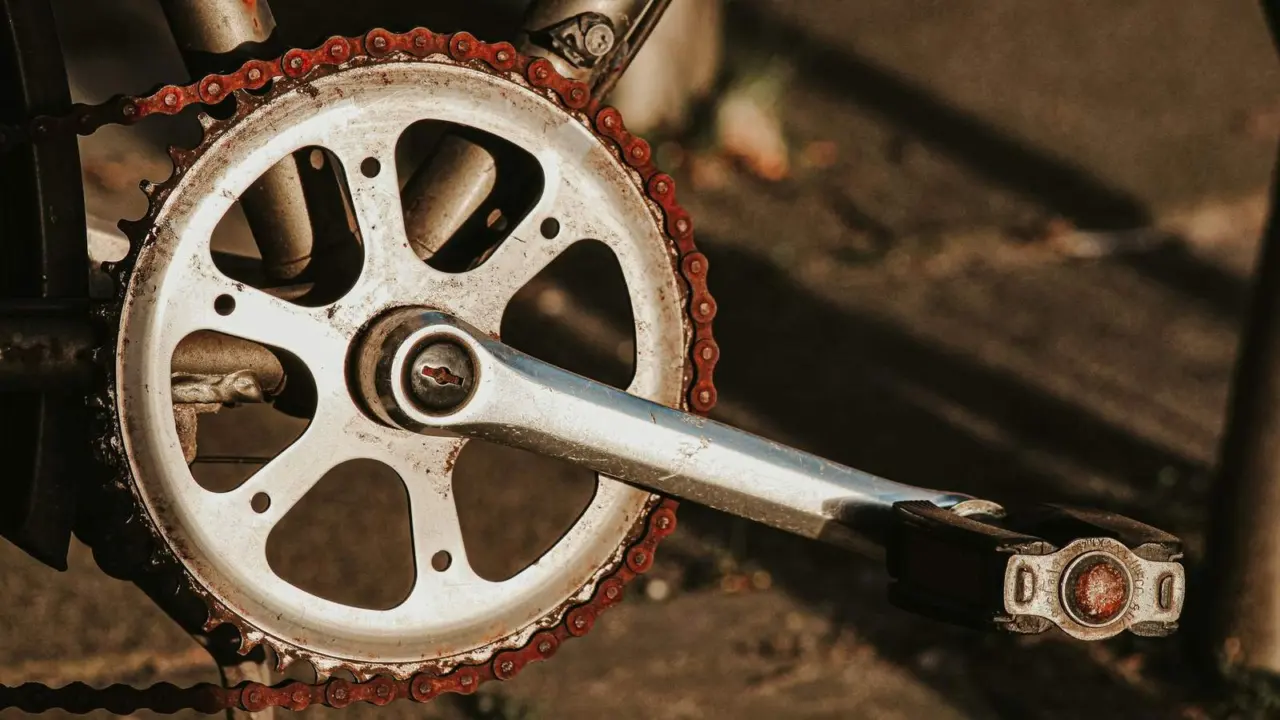
- Crank arm or spider: gauges are bonded to the crank, so the meter reads the flex of the part you push on. See our guide to the crank based power meter for the trade-offs.
- Pedal axle: the gauges read the load where your shoe meets the bike. Our page on power meter pedals covers how these are fitted and moved between bikes.
- Hub or bottom bracket: the sensor reads torque further along the drivetrain.
Because each sensor sees a different slice of the drivetrain, the position also shapes which pedalling effort is captured. A meter on one crank arm, for example, sees one leg directly.
How cadence is measured
Torque alone is not power. Cyclists Hub says power meters pair strain gauges with cadence, which can be measured with an accelerometer or, in some cases, an external magnet.
An accelerometer inside the unit senses the rotation of the crank, so no separate magnet or sensor needs to be fitted. Where a meter sits away from the crank, the rotation speed has to be obtained or inferred another way, which is worth checking in the maker’s documentation.
Cyclists Hub also points out that some products skip strain gauges entirely and estimate power from other sensors such as an accelerometer, speed sensor, wind pressure sensor and elevation sensor. That is a different method with its own limits.
From sensor to bike computer
Once the unit has a power reading, it has to send it somewhere. Wikipedia explains that older meters used wires to reach a computer on the bike, which made cleaning harder.
Modern units generally transmit over ANT+ or Bluetooth Low Energy and pair with standard bike computers. Your head unit then shows the number as you ride.
The payoff is immediacy. Wikipedia gives the example of an interval session where you can see you are producing 300 watts straight away, instead of waiting for your heart rate to climb.
Why zero offset and temperature matter
The gauge reading at rest, with no load, is the baseline. Checking it is called a zero offset, and reviewer DC Rainmaker describes it as a form of calibration you should check regularly.
In his Quarq DZero review, he says the number will generally shift slightly with temperature, though in rare cases it can change dramatically if something has gone wrong with the unit. He does one before each ride after taking the bike outdoors, in his words.
To do it, follow your power meter’s zero-offset instructions, which usually means taking the load off the pedals, positioning the cranks as the maker specifies and running the “calibrate” or “zero offset” command on your head unit. The wording varies by head unit, and you can read the full explanation in the review.
The same review notes that this brand records how each unit responds to a wide temperature range at the factory, a process it calls 10K temperature compensation. Other makers handle temperature in their own ways, so read your manual.
Power versus heart rate
Power is useful because it is a direct output. Wikipedia says power meters give instant feedback and measure your actual output, while heart rate monitors measure the physiological effect of effort and therefore ramp up more slowly.
That difference changes how you can train. A short hard effort shows up on a power display at once, while heart rate lags behind and may barely register the effort before it ends.
- Power: reflects what you are producing right now.
- Heart rate: reflects how your body is responding, with a delay.
- Together: they show how much a given output costs you on a given day.
Practical takeaways for readers
Knowing the mechanism helps you ask better questions when you compare units. The sensing method is the same idea across most designs, so the differences come down to placement, installation and upkeep.
- Ask where the strain gauges sit, since that decides what the meter can see.
- Ask how cadence is obtained, whether by accelerometer or a magnet.
- Check which wireless protocols the unit transmits, and whether your head unit supports them.
- Learn the zero offset routine for your head unit before your first ride.
Maker documentation and independent reviews are the best place to check specifics, because designs and firmware change over time.
Frequently asked questions
Do power meters measure watts directly?
Show answer
No. Most measure torque with strain gauges and combine it with angular velocity to calculate power, as Wikipedia describes.
How does a power meter know my cadence?
Show answer
Commonly through an accelerometer, or in some cases an external magnet, according to Cyclists Hub.
Do all power meters use strain gauges?
Show answer
Most do, but Cyclists Hub notes some products estimate power from other sensors instead of strain gauges.
Why should I zero my power meter?
Show answer
The zero offset can shift slightly with temperature, so re-checking it keeps the baseline honest. Follow your head unit’s calibrate or zero offset command.